A bookmark lives a harder life than almost any other small printed piece. It gets slid between pages, jammed into a bag, bent around a paperback spine, and handled with the same fingers that just held a sandwich. The single decision that most determines whether it survives that treatment is the stock it is printed on. Weight, caliper, and finish are not cosmetic choices; they set how the finished piece feels in the hand and how long it lasts. This guide walks through what those numbers mean and how to read them before you approve a run.
What a “point” actually measures
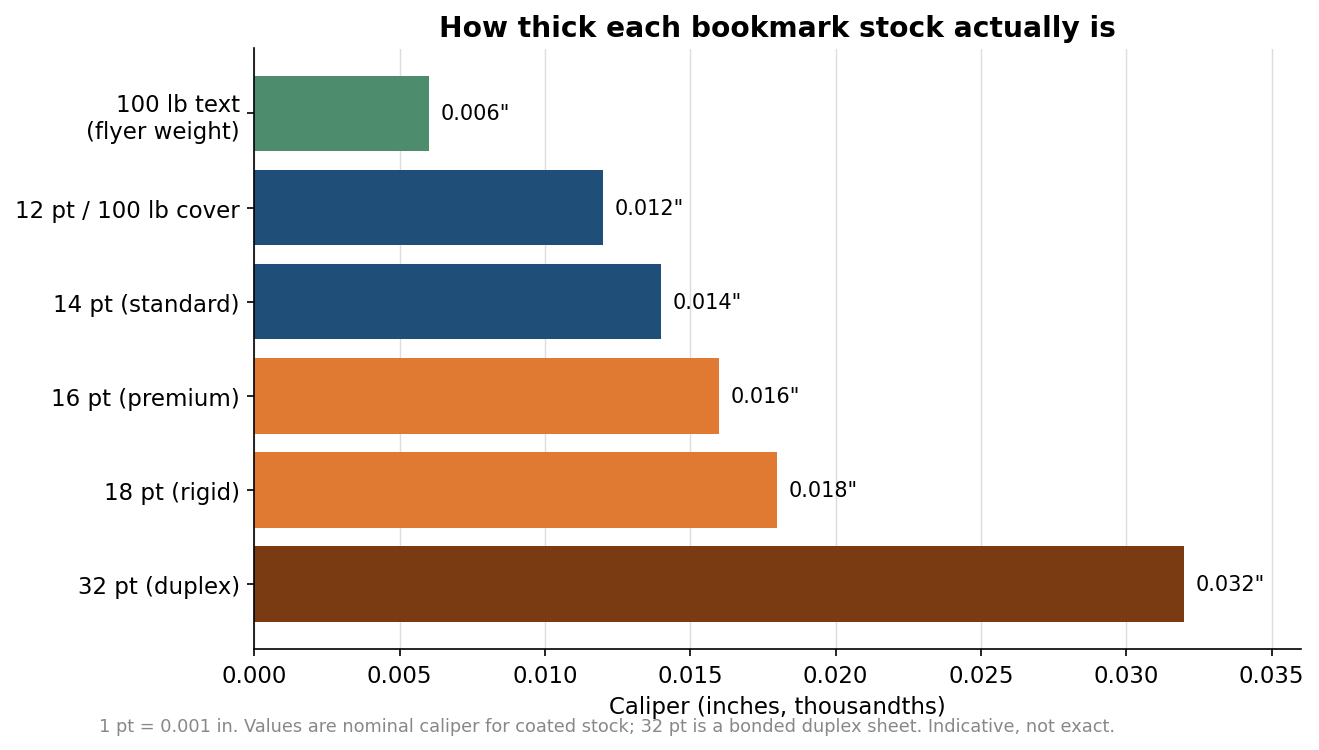
Points measure thickness, not weight. One point equals one thousandth of an inch of caliper, so a 14 pt card is 0.014 inches thick and a 16 pt card is 0.016 inches. This is a physical measurement you can take with a micrometer, which is why print shops quote bookmarks in points rather than pounds. Pound weights are the older system and they are frustratingly ambiguous: 100 lb text is a thin flyer paper, while 100 lb cover is roughly twice as stiff, because the two are weighed on different basis sizes. When a supplier lists a bookmark as “100 lb,” always ask whether that is text or cover, because the difference in the hand is dramatic. Grams per square meter, or gsm, is the metric equivalent and the least ambiguous of the three, since it is simply the weight of one square meter of the sheet regardless of how it is cut.
The common bookmark stocks, weight by weight
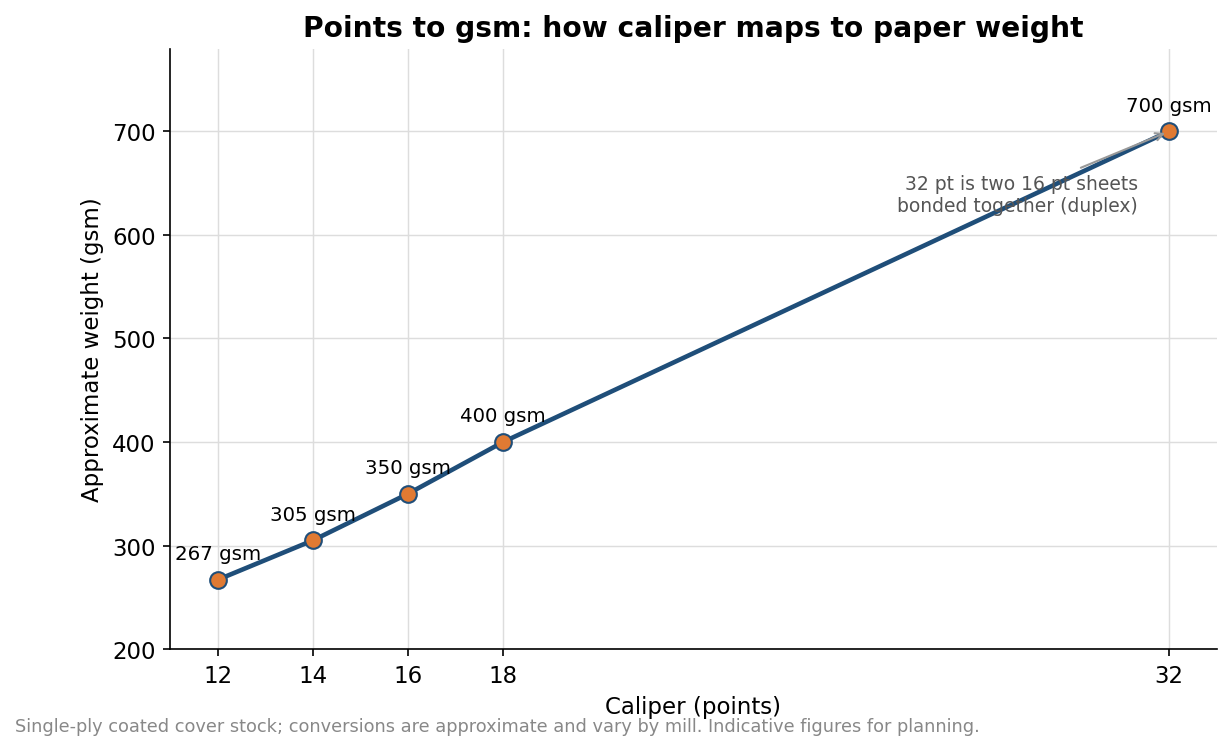
14 pt is the working standard for printed bookmarks, and for good reason. At about 0.014 inches and roughly 300 to 310 gsm, it is stiff enough to stand up on its own without being so rigid that it cracks when a reader bends it around a spine. It takes full-color printing cleanly and pairs well with lamination. If you order a bookmark and do not specify the stock, 14 pt is usually what you get.
16 pt is the upgrade most buyers can feel. The jump from 0.014 to 0.016 inches sounds trivial on paper, but the extra caliper reads as noticeably more substantial in the hand and resists dog-earing better. It sits at roughly 350 gsm and is the sweet spot for retail bookmarks, author merchandise, and anything meant to feel like a keepsake rather than a giveaway. Above that, 18 pt and heavier stocks become genuinely rigid; they are excellent for durability but start to feel like a small ruler, and they can crease rather than flex if a reader forces them.
At the top end, 32 pt is not a single sheet at all. It is two 16 pt sheets bonded together, often with a colored core showing at the edge as a design feature. It is luxury territory, priced accordingly, and overkill for a bookmark that will simply mark a page. At the other extreme, anything in the 100 lb text range, around 0.006 inches, is really flyer paper. It can work for a promotional insert that is expected to be thrown away, but it will soften and curl within days of real use. The chart below shows how caliper and gsm track together across the range.
Where durability really comes from: lamination and coating
Stock choice sets the baseline, but lamination is what actually keeps a bookmark alive. A plastic film bonded to both sides adds roughly 0.003 to 0.005 inches of total thickness and, more importantly, seals the printed surface against moisture, oils, and abrasion. An unlaminated 14 pt bookmark will soften at the corners and pick up grime within a few weeks of daily handling; the same card laminated can last years. For a piece that is defined by being touched constantly, lamination is closer to a requirement than an upgrade.
The finish you choose changes both look and behavior. Gloss lamination makes colors pop and shrugs off water, but it shows fingerprints and throws glare under a reading lamp. Matte lamination is low-glare and feels smooth and modern, though it can show scuff marks over time and mutes color slightly. Soft-touch, or suede, lamination has a velvety feel that reads as premium, but it mutes color the most and is the easiest to scuff. One practical note that buyers often miss: none of these films take pen ink well, so if the bookmark needs a space for a handwritten name or a reading date, leave an unlaminated spot-varnish window or choose a lighter coating there. UV coating is a thinner alternative that adds shine and some protection without the full thickness of a laminate, but it does not match lamination for edge durability.
Matching the stock to how the bookmark will be used
Work backward from the job. A conference or bookstore giveaway that people may or may not keep does not justify heavy stock; 14 pt with gloss lamination looks sharp, survives a tote bag, and keeps the unit cost sensible. An author’s signing table or a boxed gift set rewards 16 pt with a matte or soft-touch finish, where the added heft and quieter surface signal that the piece is meant to be kept. A library or classroom bookmark that will be handled by hundreds of readers should be laminated 16 pt at minimum, because the failure mode there is thousands of small bends rather than a single drop.
Two structural choices interact with stock. Adding a die-cut shape or rounded corners is easier and cleaner on 14 to 16 pt than on very rigid 18 pt or duplex stock. Punching a hole for a tassel or ribbon puts stress on one end, so a laminated card resists tearing there far better than a bare one, and a slightly heavier stock gives the punch more material to hold. None of these numbers are exact promises; caliper varies by a few thousandths between mills, and gsm conversions are approximate. Treat the figures here as planning ranges, ask your printer for a physical sample swatch before a large run, and judge the final choice with the card in your hand rather than on a spec sheet.